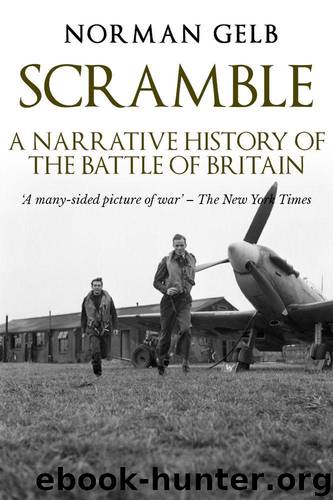
Scramble: A Narrative History of the Battle of Britain by Norman Gelb
Author:Norman Gelb
Language: eng
Format: mobi
Publisher: Endeavour Press
Published: 2016-08-08T23:00:00+00:00
CRISIS
As August drew to a close, the Germans, led by faulty intelligence into believing Fighter Command was on the verge of collapse, moved in for the kill. Ranging far and wide over southern England, the Luftwaffe sharply stepped up its attack, particularly on RAF airfields. The raids came over in such numbers that Operations Room Controllers had trouble determining which deserved priority attention from the limited defence resources at their disposal. It had by now become routine for sections of three aircraft or flights of six to be sent up against thirty, fifty, a hundred or more attacking aircraft. Such odds inevitably meant mounting casualties. Before long, only the very lucky squadron in the south still had enough men to put twelve planes aloft.
This third phase of the Battle of Britain lasted fourteen days, from 24 August to 6 September. During that brief episode, British defences came close to collapse. The stress of combat encounters several times a day every day from first light to last exhausted Fighter Command pilots. There were mistakes and accidents. Morale began to slip among the veterans, who saw friends with whom they had flown since the outbreak of hostilities fall one by one to enemy action. During this two-week period, Fighter Command lost one quarter of its pilots — killed or seriously wounded.
*
Air Chief Marshal Sir Hugh Dowding
A fresh squadron coming into an active Sector would generally bring with them sixteen aircraft and about twenty trained pilots. They would normally fight until they were no longer capable of putting more than nine aircraft into the air, and then they had to be relieved. This process occupied different periods according to the luck and skill of the unit. The normal period was a month to six weeks, but some units had to be replaced after a week or ten days ... By the beginning of September, the incidence of casualties became so serious that a fresh squadron would become depleted and exhausted before any of the resting and reforming squadrons was ready to take its place. Fighter pilots still could not be turned out by the training units in numbers sufficient to fill the widening gaps in the fighting ranks. Transfers were made from the Fleet Air Arm and from the Bomber and Coastal Commands, but these pilots naturally required a short flying course on Hurricanes and Spitfires and some instruction in formation flying, fighter tactics and interception procedure.
*
Flight Lieutenant Alan Deere
Our morale was getting a bit low because there were only three of us — George Gribble, Colin Gray and me — left in the squadron who had any combat experience. We had been there the whole time and were pretty tired. Each time we went up, there seemed to be more and more Germans up there. We’d gone through two squadron commanders. The new pilots who came in — they just went up and came down! You’d say to them, ‘Now, look, don’t get yourself lost. Stick with us. Don’t bother about shooting to start with.
Download
This site does not store any files on its server. We only index and link to content provided by other sites. Please contact the content providers to delete copyright contents if any and email us, we'll remove relevant links or contents immediately.
| Africa | Americas |
| Arctic & Antarctica | Asia |
| Australia & Oceania | Europe |
| Middle East | Russia |
| United States | World |
| Ancient Civilizations | Military |
| Historical Study & Educational Resources |
The Radium Girls by Kate Moore(12036)
100 Deadly Skills by Clint Emerson(4932)
Rise and Kill First by Ronen Bergman(4797)
The Templars by Dan Jones(4695)
The Doomsday Machine by Daniel Ellsberg(4493)
The Rape of Nanking by Iris Chang(4224)
Killing England by Bill O'Reilly(4008)
Stalin by Stephen Kotkin(3973)
Hitler in Los Angeles by Steven J. Ross(3949)
12 Strong by Doug Stanton(3555)
Hitler's Monsters by Eric Kurlander(3352)
Blood and Sand by Alex Von Tunzelmann(3207)
The Code Book by Simon Singh(3197)
Darkest Hour by Anthony McCarten(3137)
The Art of War Visualized by Jessica Hagy(3014)
Hitler's Flying Saucers: A Guide to German Flying Discs of the Second World War by Stevens Henry(2759)
Babylon's Ark by Lawrence Anthony(2686)
The Second World Wars by Victor Davis Hanson(2529)
Tobruk by Peter Fitzsimons(2521)
